

Showing posts with label Omer Yaniv. Show all posts
Showing posts with label Omer Yaniv. Show all posts
Friday, January 4, 2019
Wednesday, October 24, 2018

Wednesday, August 8, 2018
Municipal Election - the Interactive Version
In 2013, only 39.1% of Jerusalem residents voted in the municipal elections. The low voter turnout was mainly due to the low participation, only 1.6%, of Arab East Jerusalem residents. 55.3% of Jerusalem’s non-Arab residents participated in the election.
Neighborhoods with the highest voting rate were Ramat-Shlomo (82.2%), Ramot-Alon North (72.5%) and Giv'at-Shaul (71.4%). The lowest voting rates in non-Arab neighborhoods were in the City Center (35.2%), Musrara (37.2%) and Ge'ula & Mea She'arim (38.2%).
Want to know the number and percentage of votes that each party received in previous elections and by neighborhood? Want to do your own research and analysis?
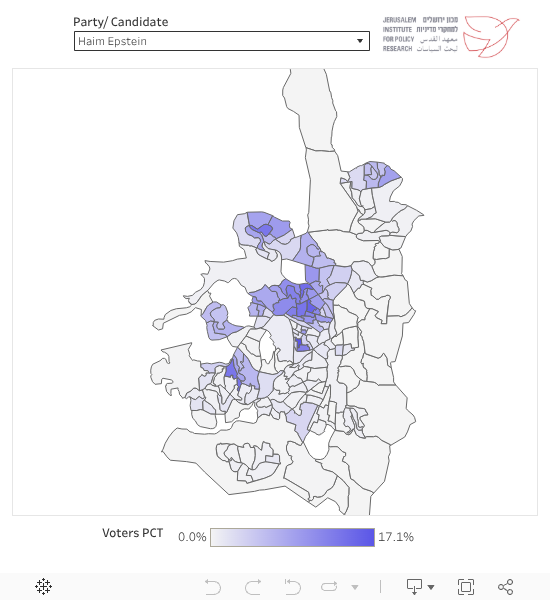
Neighborhoods with the highest voting rate were Ramat-Shlomo (82.2%), Ramot-Alon North (72.5%) and Giv'at-Shaul (71.4%). The lowest voting rates in non-Arab neighborhoods were in the City Center (35.2%), Musrara (37.2%) and Ge'ula & Mea She'arim (38.2%).
Want to know the number and percentage of votes that each party received in previous elections and by neighborhood? Want to do your own research and analysis?
Friday, July 13, 2018
In the Material World
Omer Yaniv
Since Jerusalem is a relatively poor city in comparison to other large Israeli cities, one would anticipate that fewer households would possess durable goods, since the prices of some of them are quite high. Further, a considerable percentage of the city's residents are Haredim and Arabs, who either consider some of these products to be luxuries or for whom it isn't "religiously" acceptable to have them. Thus we can understand why the rate of ownership in Jerusalem of certain durable goods is lower than it is in other cities. And yet, Jerusalem's character reveals surprising findings with respect to the ownership of several products.

Since Jerusalem is a relatively poor city in comparison to other large Israeli cities, one would anticipate that fewer households would possess durable goods, since the prices of some of them are quite high. Further, a considerable percentage of the city's residents are Haredim and Arabs, who either consider some of these products to be luxuries or for whom it isn't "religiously" acceptable to have them. Thus we can understand why the rate of ownership in Jerusalem of certain durable goods is lower than it is in other cities. And yet, Jerusalem's character reveals surprising findings with respect to the ownership of several products.

Friday, April 27, 2018
Boys' Names
Omer Yaniv
Congratulations! It's a boy! What's his name? If he was born in Jerusalem in 2016, there's a good chance that his name is David, since that was the most popular name for Jewish boys born in that year, during which 287 boys were named David. Unlike in Jerusalem, the most popular name for Jewish boys in all of Israel was Noam, with the name David ranked second place. Among Muslim boys in Israel the name Muhammad was the most popular, and it is also the most popular among all boys in Israel. The name Noam for a boy (it is also a girl's name) was also the most popular name in several Israeli cities, such as Haifa, Beersheba and Rishon Lezion, while in Jerusalem the name Noam was in 16th place on the list of the most popular Jewish boys' names. In Tel Aviv, the names Ori or Uri (which are spelled in exactly the same way in Hebrew) were the most popular.
The ten most popular names for Jewish boys in Jerusalem, apart from David, were Yosef (272 boys), Avraham (246), Moshe (233), Yehuda (212), Yisrael (210), Shmuel (184), Ya'acov (182), Yitzhak (162), and Haim (152). Apart from Noam and David, the most popular names in Israel for Jewish boys were Ori or Uri, Ariel and Yosef. In Tel Aviv the other popular boys' names were Yonatan, Adam, Noam and Eitan. In Haifa, apart from the name Noam, the most popular names were Eitan, Daniel, Adam and David. In the large localities surrounding Jerusalem the most popular name for a boy in both Beit Shemesh and Betar Ilit was Avraham; Shmuel was the most popular name in Modi'in Ilit; Noam in Mevassert Zion; Eitan in Modi'in-Maccabim- Reut; and in Ma'ale Adumim Elia was the most popular name for a boy.

Translated by Gilah Kahn
Congratulations! It's a boy! What's his name? If he was born in Jerusalem in 2016, there's a good chance that his name is David, since that was the most popular name for Jewish boys born in that year, during which 287 boys were named David. Unlike in Jerusalem, the most popular name for Jewish boys in all of Israel was Noam, with the name David ranked second place. Among Muslim boys in Israel the name Muhammad was the most popular, and it is also the most popular among all boys in Israel. The name Noam for a boy (it is also a girl's name) was also the most popular name in several Israeli cities, such as Haifa, Beersheba and Rishon Lezion, while in Jerusalem the name Noam was in 16th place on the list of the most popular Jewish boys' names. In Tel Aviv, the names Ori or Uri (which are spelled in exactly the same way in Hebrew) were the most popular.
The ten most popular names for Jewish boys in Jerusalem, apart from David, were Yosef (272 boys), Avraham (246), Moshe (233), Yehuda (212), Yisrael (210), Shmuel (184), Ya'acov (182), Yitzhak (162), and Haim (152). Apart from Noam and David, the most popular names in Israel for Jewish boys were Ori or Uri, Ariel and Yosef. In Tel Aviv the other popular boys' names were Yonatan, Adam, Noam and Eitan. In Haifa, apart from the name Noam, the most popular names were Eitan, Daniel, Adam and David. In the large localities surrounding Jerusalem the most popular name for a boy in both Beit Shemesh and Betar Ilit was Avraham; Shmuel was the most popular name in Modi'in Ilit; Noam in Mevassert Zion; Eitan in Modi'in-Maccabim- Reut; and in Ma'ale Adumim Elia was the most popular name for a boy.

Translated by Gilah Kahn
Friday, April 20, 2018
Naming your daughter
Omer Yaniv
Mazal tov, it’s a girl! What’s your baby’s name?
If she was born in 2016 in Jerusalem, there’s a good chance her name might be Sara, since this was the most popular name given to Jewish girls (232 of them) that year. In contrast, in the country as a whole, the most popular girls’ name in Israel was Tamar (Sara came in at number 8). Among Muslim girls, the most popular name was Maryam. Among Jewish girls in Tel Aviv, Haifa, Rishon Lezion and Beer sheba, Maya was the most popular name (Maya came in at No. 31 in Jerusalem).
After Sarah, the most popular names given in 2016 to Jewish girls in Jerusalem were Esther (223) Tamar and Ayala (204 each), Yael (181), Avigail, Rivka and Miriam (171 each) and Haya (157).
In Israel overall, the most common names given to girls were Tamar, Noa, Avigail, Maya and Yael. In Tel Aviv, the most popular names after Maya were Ella, Lia, Emma and Yuval. In Haifa, the most common names after Maya were Avigail, Ayala, Yael and Romi.
In haredi cities such as Beit Shemesh, Beitar Illit, and Modi’in Illit, the most common name was also Sara. In Modi’in-Maccabim-Reut and Ma’aleh Adumim, the most popular name was Talia, and in Givat Ze’ev, the most popular name was Noa.
Stay tuned next week for a list of the most popular boys’ names.

Translated by Hannah Hochner.
Mazal tov, it’s a girl! What’s your baby’s name?
If she was born in 2016 in Jerusalem, there’s a good chance her name might be Sara, since this was the most popular name given to Jewish girls (232 of them) that year. In contrast, in the country as a whole, the most popular girls’ name in Israel was Tamar (Sara came in at number 8). Among Muslim girls, the most popular name was Maryam. Among Jewish girls in Tel Aviv, Haifa, Rishon Lezion and Beer sheba, Maya was the most popular name (Maya came in at No. 31 in Jerusalem).
After Sarah, the most popular names given in 2016 to Jewish girls in Jerusalem were Esther (223) Tamar and Ayala (204 each), Yael (181), Avigail, Rivka and Miriam (171 each) and Haya (157).
In Israel overall, the most common names given to girls were Tamar, Noa, Avigail, Maya and Yael. In Tel Aviv, the most popular names after Maya were Ella, Lia, Emma and Yuval. In Haifa, the most common names after Maya were Avigail, Ayala, Yael and Romi.
In haredi cities such as Beit Shemesh, Beitar Illit, and Modi’in Illit, the most common name was also Sara. In Modi’in-Maccabim-Reut and Ma’aleh Adumim, the most popular name was Talia, and in Givat Ze’ev, the most popular name was Noa.
Stay tuned next week for a list of the most popular boys’ names.

Translated by Hannah Hochner.
Friday, February 16, 2018
Discrimination
Omer Yaniv
In a diverse society such as Israel's, we would expect that occasionally there would be friction between different people on the basis of the social variations between the groups to which they belong. We often see that people are discriminated against negatively or positively because they belong to a particular gender or to a particular ethnic or religious group. An examination of the results of the 2016 Social Survey conducted by the Central Bureau of Statistics, reveals that there were more people in the city of Jerusalem who responded that they encountered high levels of discrimination in almost all of the categories (types of discrimination) examined, than there were in Tel Aviv-Jaffa, Haifa, and the general population.
Close to 22% of respondents who live in Jerusalem said that they have encountered discrimination based on the religious group to which they belong, as opposed to about 9% in Haifa and in the general population, and about 7% in Tel Aviv. There were also a much larger percentage of respondents from Jerusalem (18%) who said that they had experienced discrimination based on nationality, as opposed to Haifa (12%), the general population in Israel (10%), and Tel Aviv-Jaffa (7%).
One of the main reasons for the differences between the populations in Jerusalem and the other cities, is that Jerusalem is the city with the most diverse population. There is a large Haredi population residing in Jerusalem (about 34% of the Jewish population) and a large Muslim population (about 36% of the total population in the city). The high percentage of Arab residents in Jerusalem (37%) as compared to the entire country (21%), Haifa (11%), and Tel Aviv-Jaffa (4%) explains the high percentage of respondents who encountered instances of discrimination based on nationality in Jerusalem. While only 8% of the Jewish respondents in Jerusalem indicated that they encountered discrimination based on their nationality, more than 38% of the Arab respondents said that they experienced this kind of discrimination. Therefore, it is reasonable to assume that a higher percentage of Jerusalem residents will encounter instances of discrimination based on religion or nationality as compared to people in all of Israel and in the other cities, where the percentage of Haredi people and Arabs is lower. Despite the great difference in percentages among Jerusalem and Israel and the two other largest cities, with respect to discrimination based on nationality, the survey revealed that from the percentage of respondents who were asked whether they encountered discrimination related to their nationality at work, only a low percentage (3%) both in Jerusalem and in the rest of the country, reported that they encountered discrimination related to their nationality at work. The only area where the survey found that residents of Jerusalem encountered less discrimination than was encountered in Tel Aviv-Jaffa was in the area of discrimination based on age. About 10% of the residents of Tel Aviv-Jaffa responded that they encountered age-based discrimination, as opposed to 8% of the residents of Jerusalem, and 7% of the residents of all of Israel and of Haifa. Also at the work place a higher percentage (6%) of the residents of Tel Aviv-Jaffa encountered age-based discrimination than did residents of Jerusalem (about 4%).

Translation: Gilah Kahn
Sources:
The Social Survey, Central Bureau of Statistics
Statistical Yearbook of Jerusalem
In a diverse society such as Israel's, we would expect that occasionally there would be friction between different people on the basis of the social variations between the groups to which they belong. We often see that people are discriminated against negatively or positively because they belong to a particular gender or to a particular ethnic or religious group. An examination of the results of the 2016 Social Survey conducted by the Central Bureau of Statistics, reveals that there were more people in the city of Jerusalem who responded that they encountered high levels of discrimination in almost all of the categories (types of discrimination) examined, than there were in Tel Aviv-Jaffa, Haifa, and the general population.
Close to 22% of respondents who live in Jerusalem said that they have encountered discrimination based on the religious group to which they belong, as opposed to about 9% in Haifa and in the general population, and about 7% in Tel Aviv. There were also a much larger percentage of respondents from Jerusalem (18%) who said that they had experienced discrimination based on nationality, as opposed to Haifa (12%), the general population in Israel (10%), and Tel Aviv-Jaffa (7%).
One of the main reasons for the differences between the populations in Jerusalem and the other cities, is that Jerusalem is the city with the most diverse population. There is a large Haredi population residing in Jerusalem (about 34% of the Jewish population) and a large Muslim population (about 36% of the total population in the city). The high percentage of Arab residents in Jerusalem (37%) as compared to the entire country (21%), Haifa (11%), and Tel Aviv-Jaffa (4%) explains the high percentage of respondents who encountered instances of discrimination based on nationality in Jerusalem. While only 8% of the Jewish respondents in Jerusalem indicated that they encountered discrimination based on their nationality, more than 38% of the Arab respondents said that they experienced this kind of discrimination. Therefore, it is reasonable to assume that a higher percentage of Jerusalem residents will encounter instances of discrimination based on religion or nationality as compared to people in all of Israel and in the other cities, where the percentage of Haredi people and Arabs is lower. Despite the great difference in percentages among Jerusalem and Israel and the two other largest cities, with respect to discrimination based on nationality, the survey revealed that from the percentage of respondents who were asked whether they encountered discrimination related to their nationality at work, only a low percentage (3%) both in Jerusalem and in the rest of the country, reported that they encountered discrimination related to their nationality at work. The only area where the survey found that residents of Jerusalem encountered less discrimination than was encountered in Tel Aviv-Jaffa was in the area of discrimination based on age. About 10% of the residents of Tel Aviv-Jaffa responded that they encountered age-based discrimination, as opposed to 8% of the residents of Jerusalem, and 7% of the residents of all of Israel and of Haifa. Also at the work place a higher percentage (6%) of the residents of Tel Aviv-Jaffa encountered age-based discrimination than did residents of Jerusalem (about 4%).

Translation: Gilah Kahn
Sources:
The Social Survey, Central Bureau of Statistics
Statistical Yearbook of Jerusalem
Friday, November 24, 2017
Putting Food on the Table
Omer Yaniv
Data accumulated from the Household Expenditure Survey carried out by the Central Bureau of Statistics show that the average household expenditure in Jerusalem is lower than the national average. In 2015, the average household expenditure in an Israeli household was NIS 15,410 a month, while in Jerusalem the average household expenditure was NIS 13,420 – lower than the average household expenditure in Tel Aviv (NIS 17,710) and higher than the average household expenditure in Haifa (NIS 12,253).
An examination of household expenditure on food (excluding fruits and vegetables) reveals that the average household expenditure on food in Jerusalem (NIS 1,850) is also lower than the national average, which stands at NIS 2,030. In this instance as well the expenditure in Jerusalem is lower than that in Tel Aviv (NIS 2,240), but higher than the household expenditure in Haifa (NIS 1,670).
The main reason for the high household expenditure on food in Tel Aviv relative to Jerusalem derives from the high expenditure of Tel Aviv residents on meals outside their homes. The survey results show that in 2015 a household in Tel Aviv spent an average of NIS 1,020 a month on meals outside the house, as opposed to only NIS 260 a month spent by a Jerusalem household, and NIS 460 a month by a household in Haifa (while the national average is NIS 440 a month).
When examining the expenditure clauses for the purchase of food products it becomes apparent that Jerusalem households generally spent more than households in Tel Aviv and in Haifa. Jerusalem households usually spent 88% more than households in Tel Aviv, and 72% more than households in Haifa on meat and poultry; about 36% more than in Tel Aviv and 27% more than in Haifa on bread, grains, and baked goods; and about 28% more than households in Tel Aviv and 47% more than Haifa households on fruit and vegetables. However, on alcoholic beverages, Jerusalem households spent 71% less than households in Tel Aviv, and 45% less than households in Haifa.

Data accumulated from the Household Expenditure Survey carried out by the Central Bureau of Statistics show that the average household expenditure in Jerusalem is lower than the national average. In 2015, the average household expenditure in an Israeli household was NIS 15,410 a month, while in Jerusalem the average household expenditure was NIS 13,420 – lower than the average household expenditure in Tel Aviv (NIS 17,710) and higher than the average household expenditure in Haifa (NIS 12,253).
An examination of household expenditure on food (excluding fruits and vegetables) reveals that the average household expenditure on food in Jerusalem (NIS 1,850) is also lower than the national average, which stands at NIS 2,030. In this instance as well the expenditure in Jerusalem is lower than that in Tel Aviv (NIS 2,240), but higher than the household expenditure in Haifa (NIS 1,670).
The main reason for the high household expenditure on food in Tel Aviv relative to Jerusalem derives from the high expenditure of Tel Aviv residents on meals outside their homes. The survey results show that in 2015 a household in Tel Aviv spent an average of NIS 1,020 a month on meals outside the house, as opposed to only NIS 260 a month spent by a Jerusalem household, and NIS 460 a month by a household in Haifa (while the national average is NIS 440 a month).
When examining the expenditure clauses for the purchase of food products it becomes apparent that Jerusalem households generally spent more than households in Tel Aviv and in Haifa. Jerusalem households usually spent 88% more than households in Tel Aviv, and 72% more than households in Haifa on meat and poultry; about 36% more than in Tel Aviv and 27% more than in Haifa on bread, grains, and baked goods; and about 28% more than households in Tel Aviv and 47% more than Haifa households on fruit and vegetables. However, on alcoholic beverages, Jerusalem households spent 71% less than households in Tel Aviv, and 45% less than households in Haifa.
Household expenses on food products, by main clauses:

Translation:Gilah Kahn
Sunday, July 23, 2017
The Silver Screen
Omer Yaniv
In 2008, The Jerusalem Film & Television Fund set up operations in the city, tasked with promoting the production of audio-visual works with Jerusalem as their focus, and also expanding employment possibilities for Jerusalemites in the film industry.
The Fund's staff assists local and international filmmakers to produce works for film and television in the city, in the same way that funding bodies and film foundations do in other cities and countries around the world, where they have learned that the production of films and TV series, with their support, contributes to the image of a place, augments the development of a creative society, and positions the locale as a tourist destination. Furthermore, the production of films and TV series in Jerusalem also provides employment for a second circle, comprised of drivers, catering services, hotels, and more.
Between the years 2010 and 2016 the Fund supported the production of eight television series and 48 films, among them international productions (such as A Tale of Love and Darkness, directed by Natalie Portman, and Norman, starring Richard Gere) and animated films, produced at an animation studio that was opened in the city several years ago.
The Fund assists filmmakers by covering some of the production costs, providing guidance and assistance in dealing with bureaucracy, identifying possible locations for filming, and providing connections to industry people who work in the city.
According to statistics based on Israeli filmgoers, the following are among the most successful films from those produced with the support of the Jerusalem Film & Television Fund during the years 2010 to 2016: Footnote, directed by Joseph Cedar, in 2011, viewed by approximately 290,000 people in Israel, with an income of 10.3 million shekels from screenings at cinemas (Footnote was nominated for the Oscar for Best Foreign Film); Bethlehem, directed by Yuval Adler in 2013, viewed by 165,000 people in Israel, with an income of 6.3 million shekels; Hunting Elephants, directed by Reshef Levy in 2013, viewed by 164,000 people in Israel, with an income of 4.9 million shekels; and The Kind Words, directed by Shemi Zarhin in 2015, viewed by 150,000 people in Israel, with an income of 4.4 million shekels.

Translation: Gilah Kahn
In 2008, The Jerusalem Film & Television Fund set up operations in the city, tasked with promoting the production of audio-visual works with Jerusalem as their focus, and also expanding employment possibilities for Jerusalemites in the film industry.
The Fund's staff assists local and international filmmakers to produce works for film and television in the city, in the same way that funding bodies and film foundations do in other cities and countries around the world, where they have learned that the production of films and TV series, with their support, contributes to the image of a place, augments the development of a creative society, and positions the locale as a tourist destination. Furthermore, the production of films and TV series in Jerusalem also provides employment for a second circle, comprised of drivers, catering services, hotels, and more.
Between the years 2010 and 2016 the Fund supported the production of eight television series and 48 films, among them international productions (such as A Tale of Love and Darkness, directed by Natalie Portman, and Norman, starring Richard Gere) and animated films, produced at an animation studio that was opened in the city several years ago.
The Fund assists filmmakers by covering some of the production costs, providing guidance and assistance in dealing with bureaucracy, identifying possible locations for filming, and providing connections to industry people who work in the city.
According to statistics based on Israeli filmgoers, the following are among the most successful films from those produced with the support of the Jerusalem Film & Television Fund during the years 2010 to 2016: Footnote, directed by Joseph Cedar, in 2011, viewed by approximately 290,000 people in Israel, with an income of 10.3 million shekels from screenings at cinemas (Footnote was nominated for the Oscar for Best Foreign Film); Bethlehem, directed by Yuval Adler in 2013, viewed by 165,000 people in Israel, with an income of 6.3 million shekels; Hunting Elephants, directed by Reshef Levy in 2013, viewed by 164,000 people in Israel, with an income of 4.9 million shekels; and The Kind Words, directed by Shemi Zarhin in 2015, viewed by 150,000 people in Israel, with an income of 4.4 million shekels.

Translation: Gilah Kahn
Tuesday, April 25, 2017
It Belongs in a Museum!
Omer Yaniv
Jerusalem Institute for Policy Research
en.jerusaleminstitute.org.il
Jerusalem is a city of museums. In the past, archaeological findings discovered in Jerusalem would be displayed in small exhibit halls primarily in the Old City’s churches and monasteries. This practice changed in 1938, when the Rockefeller Archaeological Museum was built outside of the Old City walls. Later, after the State of Israel was founded, cultural institutions opened throughout the city, including the Israel Museum in 1965, the Museum for Islamic Art in 1974, and the Bible Lands Museum as well as the Science Museum in 1992. Throughout these years museums were also opened in existing buildings, including the Tower of David Museum, the Natural History Museum, and the Old Yishuv Court Museum. In the near future Jerusalem is expected to see additional museum openings in the new “Museum Complex” surrounding the Israel Museum, where the National Campus for the Archaeology of Israel and the National Library are slated to open in the coming years.
The Israel Museum, which is Israel’s national museum, is the most popular of Jerusalem’s museums, and for good reason. In 2015 it displayed more than 290,000 collection items in 34 different exhibits, and had some 730,000 visitors. Other Jerusalem museums that drew large crowds in 2015 were the Bloomfield Science Museum with 291,000 visitors, the Tower of David Museum with 266,000 visitors, and the Bible Lands Museum with 228,000 visitors. In 2013, about 37% of all visitors to Israel’s recognized museums had visited a museum in Jerusalem. In other words, Jerusalem’s museums had more than 1,630,000 visitors, compared with 1,070,000 visitors to museums in Tel Aviv and the surrounding area (24% of all visitors to museums in Israel) and 530,000 visitors to museums in Haifa and its surroundings (12% of all visitors).

Sources: PILAT and Jerusalem Institute for Policy Research
Translated by Merav Datan
Jerusalem Institute for Policy Research
en.jerusaleminstitute.org.il
Jerusalem is a city of museums. In the past, archaeological findings discovered in Jerusalem would be displayed in small exhibit halls primarily in the Old City’s churches and monasteries. This practice changed in 1938, when the Rockefeller Archaeological Museum was built outside of the Old City walls. Later, after the State of Israel was founded, cultural institutions opened throughout the city, including the Israel Museum in 1965, the Museum for Islamic Art in 1974, and the Bible Lands Museum as well as the Science Museum in 1992. Throughout these years museums were also opened in existing buildings, including the Tower of David Museum, the Natural History Museum, and the Old Yishuv Court Museum. In the near future Jerusalem is expected to see additional museum openings in the new “Museum Complex” surrounding the Israel Museum, where the National Campus for the Archaeology of Israel and the National Library are slated to open in the coming years.
The Israel Museum, which is Israel’s national museum, is the most popular of Jerusalem’s museums, and for good reason. In 2015 it displayed more than 290,000 collection items in 34 different exhibits, and had some 730,000 visitors. Other Jerusalem museums that drew large crowds in 2015 were the Bloomfield Science Museum with 291,000 visitors, the Tower of David Museum with 266,000 visitors, and the Bible Lands Museum with 228,000 visitors. In 2013, about 37% of all visitors to Israel’s recognized museums had visited a museum in Jerusalem. In other words, Jerusalem’s museums had more than 1,630,000 visitors, compared with 1,070,000 visitors to museums in Tel Aviv and the surrounding area (24% of all visitors to museums in Israel) and 530,000 visitors to museums in Haifa and its surroundings (12% of all visitors).

Sources: PILAT and Jerusalem Institute for Policy Research
Translated by Merav Datan
Monday, January 9, 2017
Respect Their Authority
Omer
Yaniv
Jerusalem Institute for Policy Research en.jerusaleminstitute.org.il
Police data show that during the year 2014, the number of events requiring a police response in the Jerusalem District totaled 225,000, a 15% rise from 2012. During these years, a rise of 8% was recorded in the number of calls to the police emergency number 100 in Jerusalem. These calls include quarrels among neighbors and noise complaints. Criminal felonies, on the other hand, have dropped by 17% during the same years, from 5,722 in 2012 to 4,746 in 2014.
Crime, so it seems, does not reign the streets of the capital, but that's not how the residents see it. In the Social Survey conducted by the Central Bureau of Statistics, respondents were asked about their trust in the police and about their experience with crime and public order issues. In most subjects, residents of Jerusalem replied that they witnessed illegal activities in higher percentages than did the residents of Tel Aviv and Haifa, and in higher percentages than the national average.
A quarter of Jerusalem's residents said that they witnessed cases of property destruction or vandalism – more than the national average at 19%, as well as the figure in Tel Aviv and Haifa. Fourteen percent of the respondents from Jerusalem said that they have seen drug users or dealers in the city, slightly higher than the national average. Hate-crimes were also reported by Jerusalemites in higher percentages than in Haifa and Tel Aviv. quarrels among neighbors, as opposed to the above, were reported at a slightly lower percentage in Jerusalem (17%), than in Tel Aviv (18%) or Haifa (19%). Inappropriate conduct or drunkenness was reported by 18% of Jerusalem residents, compared with 22% of residents in Tel Aviv and 20% in Haifa.
Considering these data, one can understand why only 32% of Jerusalem's residents replied positively when asked whether they trust the police, compared with 40% in Tel Aviv, and 51% in Haifa.

Israel Police Statistical Yearbook
Wednesday, November 9, 2016
The Non-Accidental Tourist
Omer Yaniv
Jerusalem Institute for Policy Research www.jiis.org
Jerusalem is considered the most popular city in Israel for visitors from abroad, serving as a tourist destination with important religious and historical significance. The city has religious value for Jews, Muslims, and Christians, as well as an enormous variety of evidence and relics from different historical eras. According to data of the Central Bureau of Statistics, in 2015 about 3.1 million tourists and day-visitors entered Israel. A survey on incoming tourism conducted by the Ministry of Tourism found that 75% of the visitors to Israel during that year traveled to Jerusalem – the highest percentage among Israel’s cities.
The Old City of Jerusalem is regarded as the primary attraction for tourists from abroad, and most of the city’s popular tourist sites are located within or around the Old City. Among the main tourist sites, the Western Wall had the highest percentage of foreign tourists in 2015, at 70%. The Jewish Quarter was in second place, at 65%. Other popular tourist sites in Jerusalem include the Church of the Holy Sepulcher (49% of foreign visitors to Israel), Via Delarosa (41%), and the Mount of Olives overlook (39%). Many visitors come to these sites for religious reasons, as they are holy to Christianity and Judaism (in 2015 only 7% of Israel’s tourists from abroad visited the Al-Aqsa Mosque, which is holy to Muslims). The geographical proximity of Jerusalem’s main tourist sites boosts their popularity because it allows visitors to cover the Old City and surrounding sites within a few hours.
Examining the percentage of visitors at tourist sites by country reveals that for most countries, the Western Wall and the Jewish Quarter had the highest percentages of visitors. Overall, according to the Ministry of Tourism survey on incoming tourism, the percentage of European visitors to these sites is lower than the percentage of visitors from other continents. The survey found that in 2015, 96% of visitors from South and Central America traveled to Jerusalem, as did 91% of visitors from African countries, 89% of visitors from North America, and 79% of visitors from Asia. In contrast, only 69% of visitors from European countries traveled to Jerusalem in 2015.

Translation: Merav Datan
Monday, June 6, 2016
What's My Age, Again?
Omer Yaniv
Jerusalem Institute for Israel Studies www.jiis.org
Jerusalem today has a total of 840,000 residents, making it Israel’s most populous city. The city’s unique age distribution differentiate it from the country at large and from other cities. Among Israel’s major cities (more than 100,000 residents), Jerusalem is second only to Bnei Brak in having the youngest population: according to the Central Bureau of Statistics, over one-third of the city’s residents are below the age of 14, compared with 20% for Tel Aviv and Haifa, and 28% of the population of Israel at large. In contrast, only 15.5% of Jerusalem’s residents are 55 years old or older, compared with nearly a fifth of Israel’s residents, approximately a quarter of Tel Aviv residents, and 31.4% of Haifa residents. The median age for Jerusalem in 2015 was 23.7 years, in contrast to Israel, where the median age was 29.7. In Tel Aviv and Haifa, by comparison, the median age was 35.3 and 38.1, respectively.
An examination of Jerusalem’s internal age distribution reveals that the median age of the city’s Jewish residents, at 25.7 years, is higher than that of the Muslim population, at 20 years. The median age of West Jerusalem residents is higher than the figure for East Jerusalem: 26.3 years versus 22.3. The median age of women in Jerusalem is 24 years, higher than the figure for men, at 22.
In terms of Jerusalem neighborhoods, data from the Municipality of Jerusalem indicate that the youngest neighborhoods – those with the highest percentages of residents below age 21 – are ultra-orthodox (haredi) or located in East Jerusalem. Foremost among these are Me’a She’arim (61% of neighborhood residents), Ramat Shlomo (61%), and Kafr ‘Aqab (59%). In absolute figures, Ramot (25,440 residents), Shu’afat (19,630), and Romema (18,340) have the largest numbers of young residents. The neighborhoods with the highest percentages of elderly residents, aged 61 and above, are Talbiyeh (36%), the German Colony (31%), and Rehavia (29%). In absolute figures, Pisgat Ze’ev (6,390), Gilo (6,090), and Ramot (4,600) have the largest numbers of elderly residents.
Sources
of data: Central Bureau of Statistics, Jerusalem Institute for Israel Studies,
Municipality of Jerusalem

Tuesday, September 8, 2015
Jerusalem's Commuters
By Omer Yaniv
Morning. You’ve finished your coffee and sent the kids off to school. It’s time to go to work. But if you live in Jerusalem, your commute to work might not be so simple: Is your workplace within walking or biking distance from home? Or must you rely on a car or public transportation? As of 2013 about 61% of Jerusalem residents indicated, through the Central Bureau of Statistics Social Survey, that they have an inconvenient commute to work. One of the main reasons for this is the high percentage of Jerusalem residents who do not own a vehicle: 46%, compared with 33% for Israel at large, as of 2013. Thus, many of the city’s residents depend on transportation provided by their employer, on carpools, or on public transportation in order to reach their workplace.
The percentage of Jerusalem residents who require more than half an hour to reach their workplace is 45%, significantly higher than the national average of 33%. By comparison, the percentage of Tel Aviv and Haifa residents whose work commute takes more than half an hour is 25% and 28%, respectively. These data reflect the efficiency of public transportation systems in various cities during morning rush hour, but they might also indicate the importance of workplace proximity to home in choosing a place to live, or the lack of employment options near the city.
According to the 2008 census of the Central Bureau of Statistics, about 51% of Jerusalem’s residents commute to work by private vehicle (compared with 54% of Tel Aviv residents and 58% of Haifa residents), while 34% use public transportation or transportation arranged by the employer (compared with 28% of Tel Aviv residents and 27% of Haifa residents), and only 13% commute by bicycle or foot (comparable to the figure for Tel Aviv residents, and compared with 10% of Haifa residents). The census data also indicate that the average distance to work for Jerusalem District residents is slightly below the national average (11.4 km versus 13.6 km, respectively). Given that Jerusalem residents make greater use of public transportation, we can certainly point to a correlation between the long work commute time in Jerusalem and the extensive use of public transportation on the part of the city’s residents.

Tuesday, April 21, 2015
Where the streets have names
Omer Yaniv
How are street names chosen? Here in Jerusalem, a city with a rich history and religious symbolic importance, we can presume that there are not enough streets, alleys, roads, avenues and squares to commemorate the thousands of figures, spots and events that deserve to be remembered. At present there are over three thousand named streets and sites in the city. To successfully face a growing demand to memorialize so many people, two committees are active in the Jerusalem Municipality, a public municipal name committee and an advisory committee, which together decide whether or not the contribution and legacy of the nominated figures justifies the commemoration. Lately the municipality has been making an effort to give names to the many nameless streets of East Jerusalem, with the participation of the local residents.
A theme in street names can be found in some Jerusalem neighborhoods. Intellectuals of the Middle Ages, for example, can be found in Rehavia; the tribes of Israel, alongside biblical judges, characterize Bak'a; and animals are the theme in Malcha.
Looking at the street names in Israel as a whole, we see that plant names, and especially the seven species, are the most common. Other popular choices are the names of precious stones, animals, Jewish and Israeli leaders, military units and more. The most common street names in the country are HaZayit - 'The Olive' (225 streets around the country); HeGefen - 'The Vine' (213); HaRimon - 'The Pomegranate' (204); and HaTamar - 'The Date Palm' (174). Israel's first prime minister, David Ben-Gurion, is the most popular person among street names, with 79 streets named after him. The woman who is commemorated in the highest number of streets is Hannah Senesh - 41 streets in Israel are named after her.

Monday, October 27, 2014
Trash Talk
Omer Yaniv
Preliminary data from the report Society in Israel, published by the Central Bureau of Statistics, indicate that only 43% of Jerusalem residents are satisfied with the state of sanitation in their area of residence, compared with 55% of Tel Aviv residents and 62% of Haifa residents. In recent years the Municipality of Jerusalem has undertaken more intensive action on the issue of recycling. In 2013 approximately 66,000 tons of waste were recycled in the capital, an increase of 61% compared with 2012. Simultaneously there was an increase of nearly 100% in the amount of organic waste recycled in the city during those years.
The increased recycling of waste in Jerusalem stems, among other factors, from the addition of some 3,000 recycling containers (bins) throughout the city for the purpose of recycling metal, plastic, batteries, paper, and so on. Furthermore, in 2014 a large-scale recycling center was established in the Atarot industrial zone in order to collect waste from Jerusalem and its environs, and in August 2014 a facility for sorting and separating waste began operating within the zone. As of 2013, the percentage of recycled waste in Jerusalem – out of the total amount of waste collected – is 15.5%. With respect to the recycling of waste from recycling bins, the percentage of this type of waste that was recycled in 2012 is comparable to the national average, at approximately 7.5% (compared with 4% in 2009).
The daily production of waste per resident in Jerusalem is among the lowest in Israel, measuring 1.40 kg per capita per day in 2012. This is approximately two-thirds of the figure for Tel Aviv residents and about 19% lower than the national average, which is 1.72 kg per capita per day. In Jerusalem and its environs nearly half a million tons of waste were collected in 2012, about half the amount collected in Tel Aviv and 10.1% of the total amount of waste collected in Israel. We hope that the opening of the new recycling center will result in a significant increase in the amount of waste recycled in Jerusalem. In recent years a project was launched that aims to encourage the use of compost bins in both private gardens and community gardens. As of 2013, some 1,700 families in three community councils were using compost bins, and this year more community councils are expected to take part in this project. For additional information on this project, please contact YarokBair@ginothair.org.il.

Data sources: CentralBureau of Statistics, Press Release, September 2014; Jerusalem Municipality,
Press release, April 2014; Central Bureau of Statistics, Statistical Abstractof Israel.
(Please notice there was a mistake in the writer's name in the Jerusalem Post's print edition)
Translation: Merav Datan
Subscribe to:
Posts (Atom)